
Why Reputation Matters So Much for Roofing Companies
Roofing is a high-ticket, high-trust purchase. Homeowners aren’t making a casual decision — they’re choosing who works on one of their home’s most important protective systems, and trusting the job holds through a Canadian winter. Reviews are the fastest proof they have that you’ll follow through after the deposit clears.
Most roofing contractors treat reviews as something that happens to them, not something they manage. A missed follow-up text, an ignored one-star review, or a profile untouched in over a year sends a message about your roofing business that a competitor’s active, well-managed profile does not: proceed with caution.
What Reputation Management for Roofers Actually Includes
Reputation management for roofers isn’t a single task — it’s several connected systems working together: generating genuine reviews, responding to every one of them, monitoring your brand across platforms, and handling problems before they go public. Miss one piece and the others lose most of their value.
Review Generation Built on Genuine Feedback
Most roofing companies get reviews by accident — a happy customer remembers weeks later, if at all. We install a request sequence triggered the day a job wraps: a direct review link sent by text and email, timed while the new roof is still fresh in the homeowner’s mind.
Every request is built to capture genuine feedback, not manufacture five-star ratings. We ask every customer the same way, whether the job went perfectly or not — Google prohibits selectively soliciting positive reviews and discouraging negative ones, and we build your system to stay firmly on the right side of that line.
Professional Review Response Management
An unanswered negative review sits at the top of your profile telling every future homeowner you had nothing to say. We write and post professional responses promptly — acknowledging the concern, avoiding a public argument, and moving specifics offline when the details get personal.
Responses matter for reviewers who never complain publicly too. A homeowner comparing three roofing contractors reads how you handled criticism just as closely as they read your five-star praise — sometimes closer.
Reputation Monitoring, Including What Matters for Roofing Specifically
Monitoring means more than glancing at your Google Business Profile now and then. We track new reviews as they land, watch for rating shifts, flag anything that looks like a policy violation, and keep an eye on how your closest competitors’ review counts are moving.For roofing companies, the recurring themes worth watching are usually roofing-specific, not generic:1. Workmanship and cleanup complaints2. Communication and scheduling delays3. Warranty questions after the job is done4. Estimate-versus-final-price mismatches5. How fast a crew responds after a storm
Policy-Violating Review Management
Not every review you dislike can be removed — only ones that break platform policy. A review from someone who was never a customer, references work you never did, or comes from a competitor posing as a homeowner is eligible for removal. A harsh but genuine review from a real customer isn’t, and it’s better answered professionally than fought.
Where a review does break policy, we document the case and file the formal removal request directly with Google or HomeStars, so you’re not fighting that battle alone.
Cross-Platform Consistency: Google, HomeStars, and Facebook
Google isn’t the only place homeowners check. HomeStars is one of Canada’s most established contractor-review platforms, scoring businesses on review volume, average rating, and recency — another data point homeowners compare before they call. Facebook and BBB listings round out the picture serious buyers build.
We keep your roofing business’s name, categories, and service descriptions identical everywhere they appear, because a mismatched listing reads as a red flag to homeowners and search engines alike.
What Homeowners Look for in a Roofing Company’s Reviews
Reputation management isn’t only about search visibility — that overlaps with what our local SEO services for roofers cover. Its bigger payoff is conversion: getting the homeowner already comparing three roofing contractors to choose you, in the few seconds before they dial.
| What Homeowners Check | What Builds Trust |
|---|---|
| Star rating | A strong, genuine rating — context matters more than chasing a perfect score |
| Review volume | Enough recent reviews to show a consistent pattern, not just a handful |
| Recency | Reviews that show you’re actively serving customers now, not two years ago |
| Review responses | Thoughtful, professional replies that show you’re paying attention |
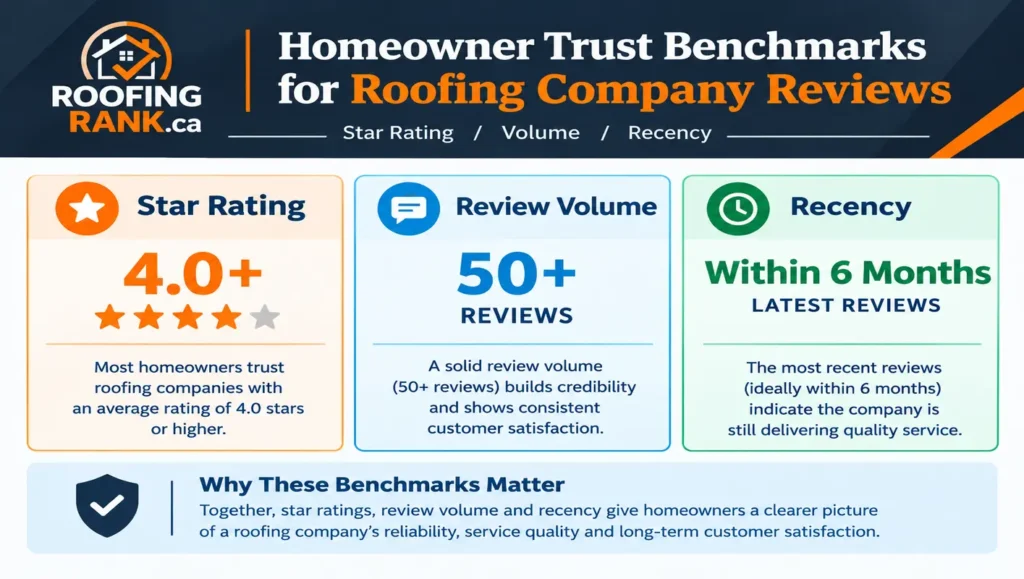
This pattern shows up across the Canadian roofing companies we work with: a roofer with excellent workmanship but a thin review profile consistently loses booked jobs to a competitor with a stronger, more active one — even when the actual work doesn’t compare.
How Reputation Signals Can Support Local & AI Search Visibility
Homeowners increasingly use AI-powered tools to research local contractors, and these systems can draw on information from your website, business listings, and reviews when generating answers. Google’s own AI-powered search experiences can also pull from Business Profile information, including reviews, when summarizing local businesses.
Consistency and accuracy across your online presence make it easier for these systems to understand and represent your roofing business correctly. Clear service information, genuine reviews, and a well-maintained Google Business Profile give search systems more reliable material to work with — which can help you show up in AI-generated answers alongside traditional results.
Why Structured Business Information Matters
Clear service pages, accurate business details, and properly structured review data give search systems machine-readable signals to work with. It isn’t a shortcut to being featured — it’s the kind of on-page SEO foundation that removes friction, so AI systems and traditional search have accurate information to summarize in the first place.
Our Process of Reputation Management for Roofers
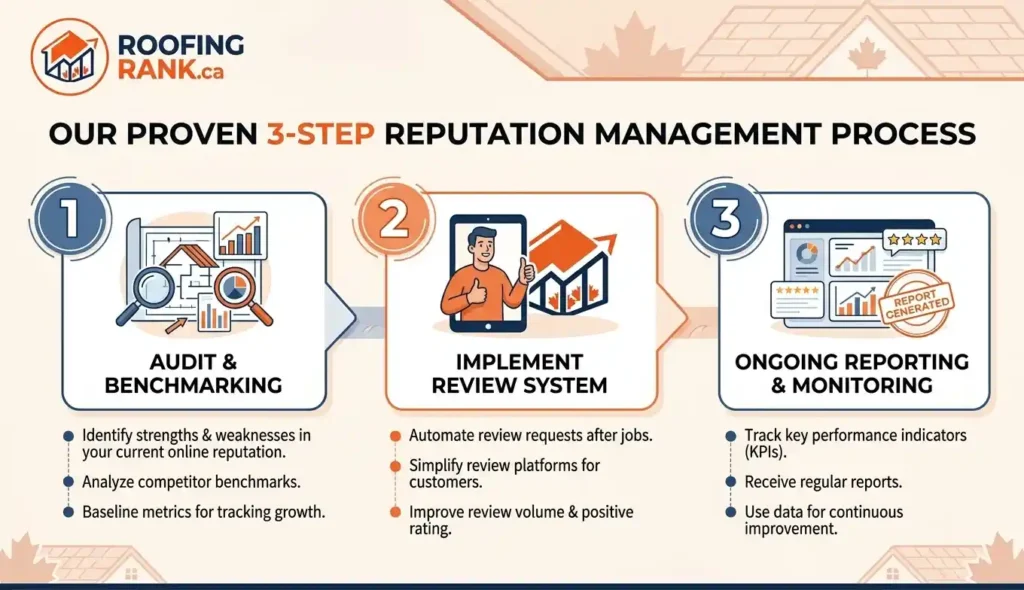
We keep the process straightforward. Every engagement starts with a full picture of where your reputation stands today, compared against the two or three roofing contractors homeowners are seeing alongside you in local search — then moves into the systems that keep it growing.
Reputation & Competitor Audit
We pull your current reviews, ratings, and response history from Google, HomeStars, and Facebook, then compare them against your closest local competitors. You get a clear picture of the gap and what’s driving it — not just a star-rating snapshot.
Review Generation & Response System
We set up the request sequence and response workflow so new reviews get requested consistently and answered within a business day or two — without you or your office manager chasing it manually between job sites.
Ongoing Monitoring & Reputation Reporting
Every month you get a clear report: reviews gained, rating movement, response times, and anything flagged for attention — the same transparent reporting style we use across every roofing SEO service we deliver, no jargon, no fluff.
Why Roofing Rank’s Approach Is Different
Roofing customers evaluate contractors differently than they’d evaluate a restaurant or a retail store. A homeowner is weighing workmanship, communication, cleanup, project timelines, and whether you’ll still answer the phone after the final invoice — not just a star rating.
That’s why our reputation systems are built around the roofing customer journey specifically — the same roofing-only focus behind every roofing SEO campaign we run, not a generic template borrowed from another home-service industry.
FAQs
How can I get more Google reviews for my roofing company?
Ask every customer within a day or two of job completion, while the new roof is still top of mind, and send the request by text or email rather than relying on a verbal ask. Asking the same way every time — not just after jobs that went perfectly — keeps your profile compliant with Google’s review policy and genuinely representative of your work. A simple follow-up a few days later, if there’s no response, typically improves completion rates.
How should a roofing company respond to a negative Google review?
Respond promptly, professionally, and without arguing publicly. Acknowledge the specific concern, avoid sharing private customer details, and invite the conversation offline if it needs more back-and-forth. Google recommends keeping responses short, relevant, and personalized rather than templated. If the review breaks Google’s content policy — for example, it’s from someone who was never a customer — you can also file a formal removal request.
Can a roofing company remove a fake or policy-violating Google review?
Yes, if it genuinely breaks Google’s policy — posted by someone who was never a customer, referencing work that never happened, or posted by a competitor. Document the details and file a removal request through Google’s official reporting tools. Reviews that are simply negative but come from a real customer generally don’t qualify for removal, even when the complaint feels unfair.
Can I remove a negative review that’s unfair but from a real customer?
Usually not. Google only removes reviews that violate its content policy, not ones a business simply disagrees with or considers unfair. The better move is a calm, professional public response that gives your side of the story — future homeowners read how you handled the criticism, and a thoughtful response often does more for your reputation than a removal request would anyway.
Does responding to reviews help my roofing company rank higher on Google?
Responding to reviews is an important part of managing a strong Google Business Profile, though Google doesn’t state that response frequency is a direct ranking factor on its own. Reviews themselves contribute to the “prominence” signal behind local ranking, and thoughtful responses show homeowners — and Google — that your business is active and engaged. Comparing your profile against a similar roofing contractor who never responds usually makes the difference clear.
How many Google reviews should a roofing company have?
There’s no universal number that guarantees trust or visibility — it depends on your market, your competitors, and what homeowners in your city are used to seeing. A roofing company in a competitive market like Toronto or Calgary typically needs a stronger profile than one in a smaller city with less competition. We benchmark your review profile against the roofing companies homeowners are actually comparing you to.
How is reputation management different from Google Business Profile optimization?
Our Google Business Profile optimization work sets up and structures your listing — categories, photos, services, and posts. Reputation management is the ongoing layer on top: generating genuine reviews, responding to every one, and monitoring your brand across Google, HomeStars, and Facebook. Most roofing contractors need both working together for consistent results.
Should I get a free audit before starting reputation management?
It helps. A free roofing SEO audit shows exactly where your reviews, ratings, and response history stand against the roofing contractors you’re actually competing with, before you spend on a fix. It also flags any policy-violating reviews worth disputing right away. Most contractors find the audit changes which part of their reputation they tackle first.
Is Your Roofing Company’s Reputation Helping You Win the Next Job?
Every week your review profile stays thin, or your last response sits unanswered, a competitor with a stronger reputation is picking up calls that could be yours. Homeowners aren’t waiting to decide — they’re calling whoever looks trustworthy in the next thirty seconds.
We’ll show you exactly where your roofing business stands against the contractors homeowners are comparing you to, and what it takes to close that gap. No pressure, no long-term contract to start.
Roofing-Exclusive
Agency Since 2022
Serving Contractors
Across Canada
Transparent
Monthly Reporting
No Long-Term
Contracts