

Technical SEO for Roofing Companies
Your roofing website can be well written and still invisible. If Google cannot crawl it, index it, or load it quickly on a phone, the content never gets a fair hearing.
Technical SEO for roofing companies fixes that foundation. We are a roofing SEO agency working only with Canadian contractors, from Ontario and Quebec through to Alberta and British Columbia. On most roofing sites we review, three or four technical faults are holding back pages that should already be ranking.
What technical SEO actually covers on a roofing website
Technical SEO is the engineering layer of your site. It decides whether search engines can discover your pages, read them correctly, and serve them fast enough that a homeowner does not leave. On a roofing site that means crawl configuration, indexation, URL and site structure, internal linking, page speed, mobile rendering, structured data, and redirect hygiene.
It is not content writing, which sits under on-page SEO. Both matter, and they work together. Technical SEO makes the page reachable and readable; on-page work makes it relevant. When the technical layer is faulty, everything built above it underperforms.
The technical faults that quietly cost roofing contractors leads
Most roofing websites are built by web designers rather than search engineers. The result looks professional and performs poorly in search. These are the faults we find most often on Canadian roofing sites:
None of these are visible to a homeowner. All of them are visible to Google.
Can Google actually reach your roofing service pages?
Indexing is not automatic. Google crawls a page, evaluates it, then decides whether to index it. A page that is never crawled cannot rank, no matter how well the copy is written.
One detail is widely misunderstood, including by some agencies. Blocking a page in robots.txt does not remove it from Google. Google’s own documentation states that a disallowed URL can still be indexed when other pages link to it, because robots.txt controls crawling rather than indexing. The correct sequence is to allow crawling, then apply a noindex rule so Google can actually read the instruction. We check this on every engagement, because the reverse setup is common on WordPress roofing sites.
Site architecture for roofers serving several cities
A contractor covering the Greater Toronto Area may want pages for Toronto, Mississauga, Brampton, Vaughan and Oshawa. The architecture question is how those pages relate to your core service pages, and whether each one earns its place in the index.
Google’s spam policies name doorway abuse directly, and cite pages targeted at specific regions or cities that funnel users to one destination, along with substantially similar pages. Swapping a city name into an otherwise identical template matches that description. We build a hierarchy where service pages sit above location pages, canonicals are set deliberately, and internal links pass authority in a chosen direction rather than by accident.
Core Web Vitals on photo heavy roofing websites
Core Web Vitals measure real user experience in three ways. Google’s published thresholds are Largest Contentful Paint at 2.5 seconds or less, Interaction to Next Paint at 200 milliseconds or less, and Cumulative Layout Shift at 0.1 or less. These are assessed on field data at the 75th percentile of real visits, not on a single lab score.
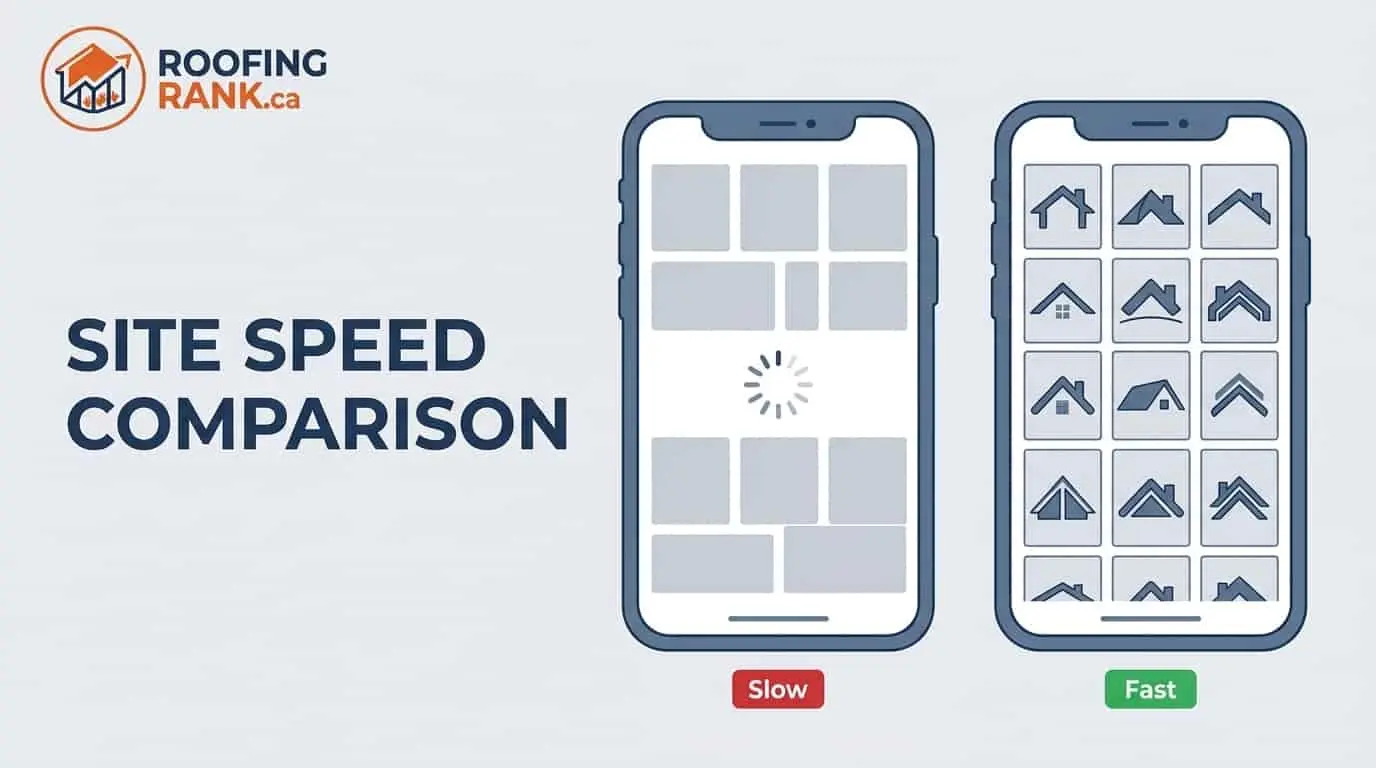
Roofing sites fail Largest Contentful Paint more often than most industries, and the cause is usually the same: before and after photography. A gallery of ten full resolution job photos can dominate mobile load time on its own. We compress and convert images to modern formats, defer what sits below the fold, reserve layout space so nothing jumps, and reduce the script weight that page builders add by default.
Structured data for roofing contractors, minus the myths
Structured data tells search engines what your business is in a machine readable form. For a roofing contractor that usually means LocalBusiness or the more specific RoofingContractor type, plus Service markup for each offering and Organization details. The rule that matters most is simple: markup must match what is visible on the page.
Here is where a lot of roofing SEO advice is now out of date. Google stopped showing FAQ rich results in Search from 7 May 2026, and removed the supporting documentation afterwards. Any proposal that still sells FAQ schema as a route to extra search real estate is quoting a feature that no longer appears. We continue to implement question and answer markup where it genuinely fits a page, because it helps retrieval systems parse content cleanly, but we will describe it to you accurately.
What a technical diagnosis usually uncovers
The example below is a composite built from the fault patterns above, rather than a specific client account. It shows how the work runs in practice.
A roofing contractor in a mid sized Ontario market rebuilds their website. Rankings for roof repair terms fade over the following weeks, while the Google Business Profile keeps performing. A crawl finds the cause in layers. Eleven service and city URLs changed during the rebuild with no 301 redirects, so Google is still holding the old addresses. The new theme dropped the LocalBusiness markup entirely. Four city pages share an identical title tag. Mobile Largest Contentful Paint sits well outside the good threshold because the gallery ships full resolution photos.
None of those faults are content problems. Each one is a specific, fixable configuration error, and they are addressed in order of ranking impact.
Redesigns and migrations, where roofing sites lose rankings overnight
A new website is the single most common cause of a sudden ranking drop for roofing contractors. URLs change, redirects get missed, schema disappears with the old theme, and internal links break at scale.
The mechanism is easy to follow. If a rebuild moves /roof-repair-toronto/ to /services/roof-repair-toronto/ without a 301 redirect, Google keeps the old URL until it recrawls and finds a 404. Rankings for that page fall away, and the new URL starts from nothing. Multiply that across twenty service and city pages and the loss is substantial. We map every URL before launch, stage the redirects, and verify indexation afterwards in Search Console.
What our technical SEO service includes
| Area | What we deliver |
|---|---|
| Crawl and index control | Full site crawl, robots.txt review, noindex and canonical configuration, XML sitemap rebuild, Search Console index coverage resolution |
| Site architecture | Page hierarchy review, internal linking plan, orphan page resolution, URL structure corrections |
| Performance | Core Web Vitals diagnosis on field data, image compression and format conversion, render blocking and script fixes, caching and server response review |
| Mobile and rendering | Checks against how Googlebot renders the page, layout stability, form responsiveness on real devices |
| Structured data | LocalBusiness or RoofingContractor, Service and Organization markup, validation, alignment with visible page content |
| Redirects and security | Redirect chain cleanup, 404 mapping, HTTPS consistency, mixed content resolution |
| Bilingual setup | Language and regional markup for contractors publishing in both English and French |
| Migration protection | Pre launch URL mapping, staged redirects, post launch indexation verification |
| Monitoring | Monthly crawl, Search Console index and Core Web Vitals tracking, plain language reporting |
How the work runs, stage by stage
We begin with a full crawl and a Search Console baseline, so every later change can be measured against a known starting point. Findings are triaged by likely ranking impact rather than by how many issues we can list.
Implementation follows in order. Indexation and architecture come first, because a fast page Google cannot index is worth nothing. Performance work follows, then structured data. We validate each change, then monitor. Core Web Vitals field data updates on a rolling 28 day window, so we do not judge a performance fix in its first week.
Setting realistic expectations
Technical SEO removes obstacles. It clears the way for your content, local signals and link building to do their work, and it is usually the fastest source of recovery when something has gone wrong. What it cannot do on its own is create demand or outrank a stronger competitor in a crowded market.
Two points are worth understanding before anyone quotes you on them. Crawl budget is real, but Google’s guidance on it is aimed at very large sites, so a roofing website with sixty pages almost never has a genuine crawl budget problem. And for AI search, Google states there are no additional technical requirements to appear in AI Overviews or AI Mode. Sound technical fundamentals are what serve you there, not a separate product.
Who this service suits, and who should wait
This work fits roofing companies that already have real content and an active presence, but are not ranking in line with that effort. It also fits contractors planning a redesign, expanding into new cities, or recovering from a drop after a rebuild.
It is not the right first spend for a new roofing business with four pages and little local footprint. In that case, local visibility and content should come first. If you are unsure which situation applies to you, a full roofing SEO audit will tell you before you commit to implementation.
Where technical SEO fits with the rest of our work
Think of it in three parts. An audit diagnoses the problem. Technical SEO builds and maintains the foundation. The visibility layer sits above it, covering local SEO for roofing companies and Google Business Profile optimization.
These are sequenced rather than interchangeable. A contractor with a fast, clean, well structured site and no local signals will not rank in the Map Pack. A contractor with strong local signals and an unindexable website will not rank organically. We tell you which end of that problem you are actually on.
Frequently Asked Questions
What is technical SEO for a roofing company?
It is the work that makes your roofing website crawlable, indexable, fast and correctly structured. It covers crawl settings, site architecture, page speed, mobile rendering, structured data and redirects.
How is technical SEO different from an SEO audit?
An audit diagnoses problems and ranks them by impact. Technical SEO is the implementation and ongoing maintenance that fixes those problems and keeps them fixed.
Why are my roofing service pages not showing in Google?
Common causes are a noindex rule left from development, a robots.txt block, thin or duplicated content, or no internal links pointing to the page. Search Console usually identifies which.
How long before technical SEO affects my rankings?
Indexation fixes can take effect within days of a recrawl. Core Web Vitals improvements take longer, because Google measures field data on a rolling 28 day window.
Does page speed really matter for a roofing website?
Yes. Most local roofing searches happen on phones, often urgently. Core Web Vitals form part of Google’s page experience signals, and slow pages lose visitors before they read anything.
Do I need schema markup on my roofing site?
It helps search engines understand your business, services and service area. It does not guarantee any rich result, and the markup must match the content visible on the page.
Will technical SEO alone get my roofing company ranking?
No. It removes obstacles so your content, local signals and reviews can perform. Ranking still depends on relevance, local prominence and competition in your market.
My roofing website was redesigned and traffic dropped. Can this be fixed?
Usually yes. Missed redirects, changed URLs, lost schema and broken internal links are the common causes. Recovery time depends on how long the issues have been live.
Do you work with WordPress roofing websites?
Yes. Most Canadian roofing sites run on WordPress, and many performance problems trace back to page builder bloat and unoptimized project photography.
Book a technical review of your roofing website
We will crawl your site, check what Google can and cannot index, measure your Core Web Vitals against real user data, and send you a prioritized list of what is holding you back. There is no obligation to continue afterwards.
Technical SEO for roofing companies is not glamorous work, and homeowners will never see it. Google sees all of it. If you want the rest of your marketing to perform, this is where it starts.
Roofing-Exclusive
Agency Since 2022
Serving Contractors
Across Canada
Transparent
Monthly Reporting
No Long-Term
Contracts